
Close Menu
    LinkedIn
    LinkedIn
    HyDynamics
    Login
    simulation demos
    • Home
    • Features
    • Politics & Projects

      In Blten, a valley without mountains: images and maps of the geopolitics of the anthropocene

      July 10, 2025

      Eureteq: Hydrogen transport and engineering

      April 7, 2025

      Choosing the American LNG would bring out the union from its climatic objectives

      March 22, 2025

      The coming catastrophe

      November 28, 2024

      CHARBONE Hydrogen Corporation: green hydrogen in eco-production

      September 2, 2024
    • H2 Technology
      1. Politics & Projects
      2. H2 Production & Storage
      3. H2 Safety & Efficiency
      4. View All

      In Blten, a valley without mountains: images and maps of the geopolitics of the anthropocene

      July 10, 2025

      Eureteq: Hydrogen transport and engineering

      April 7, 2025

      Choosing the American LNG would bring out the union from its climatic objectives

      March 22, 2025

      The coming catastrophe

      November 28, 2024

      New sustainable flow batteries on the test bench

      March 3, 2026

      Batteries and energy transition: what future for Europe?

      June 12, 2025

      Bureau Veritas, Inthy and the Bourgogne Franche-Comté region launch the first scale site dedicated to the storage of hydrogen in Europe

      April 7, 2025

      Hydrogen in industrial combustion

      March 8, 2025

      Sutec revolutionizes combustion systems with hydrogen injection

      March 7, 2025

      Parker Hannifin: Master the purification of hydrogen – a pioneer’s journey

      March 6, 2025

      How to effectively manage hydrogen

      March 5, 2025

      Hopium improves its hydrogen fuel cell: towards technological maturity

      July 29, 2024

      How to decarbonize air and maritime transport?

      July 29, 2024

      Krohne: technical expertise at the service of the Jupiter 1000 hydrogen project

      July 29, 2024
    • H2 BOOKS
    HyDynamics
    • Home
    • Politics & Projects
    • H2 Production & Storage
    • H2 Technology
    • Buy Now
    Home»H2 Production & Storage»New sustainable flow batteries on the test bench
    H2 Production & Storage

    New sustainable flow batteries on the test bench

    KAOUTARIBy KAOUTARIMarch 3, 2026No Comments3 Mins Read
    Facebook Twitter Pinterest LinkedIn Tumblr WhatsApp VKontakte Email
    Share
    Facebook Twitter LinkedIn Pinterest Email

    A key advance for clean energy storage

    The race towards more sustainable energy storage solutions takes a new step with recent work carried out by Bordeaux researchers, in collaboration with a Japanese team. Their results, published in the Journal of Power Sourceslay the foundations for a better understanding of organic flow batteries – a promising technology for the energy transition.

    What is a flow battery?

    Unlike conventional batteries (such as lithium ones), flow batteries store energy in electrolytic liquids that circulate between two reservoirs before being pumped into an electrochemical cell where the chemical energy is converted into electricity. This architecture allows separate storage capacity and powermaking this type of battery particularly interesting for large-scale storage installations, such as electricity networks or renewable systems.

    Historically, these batteries used inorganic electrolytes – often based on heavy metals such as vanadium – which poses constraints of cost, toxicity and sustainability. This is why the scientific community is increasingly interested in safer and more environmentally friendly alternatives.

    An organic and biocompatible solution

    The innovation highlighted by the researchers focuses on the use of biocompatible organic electrochemical couplesin particular the duo methyl-viologen / 4‑hydroxy-TEMPO (MV / 4‑HO-TEMPO). These molecules, simpler to synthesize and less toxic than traditional electrolytes, open the way to more sustainable flow batteries – both economically and environmentally.

    To optimize these new systems, it is essential to understand precisely how reactions take place at the interface between the electrolyte and the electrodes. This is where the research team from the Institute of Mechanics and Engineering of Bordeaux (I2M, CNRS / Arts et Métiers / University of Bordeaux) comes in, in partnership with the University of Tokyo.

    Innovative imaging for more efficient batteries

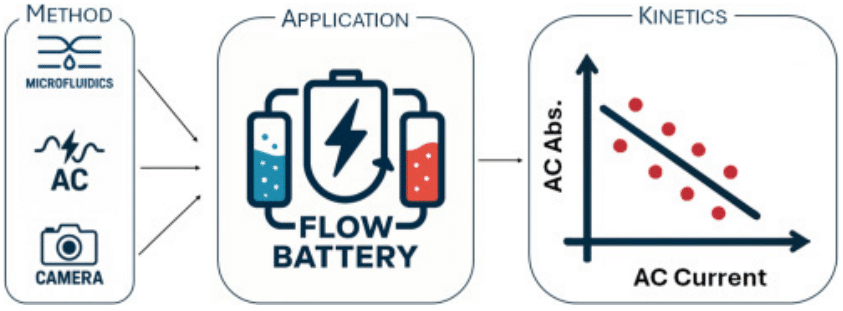
    Scientists have adapted a spectroelectrochemical imaging technique which makes it possible to map in detail the concentration variations and kinetic constants of organic electrolytes within a microchip. Using a microscope and a camera, they modulate the applied voltage and film the evolution of the reagents, making it possible to link optical measurements to real electrical performance.

    These maps provide valuable information for adjust the cell design and operating conditions future prototypes. In particular, they make it possible to quickly identify areas where reactions are inefficient or where energy losses could occur, thus accelerating the optimization of these technologies.

    A step towards sustainable storage of renewable energy

    This work demonstrates that organic flow batteries have a real potential for clean energy storageparticularly for stationary applications linked to renewable energies. By making the measurement of kinetic properties more precise and faster, the new approach facilitates the design of more efficient and sustainable systems.

    Although there is still a way to go before large-scale industrialization, this research constitutes a key step in optimizing storage technologies that are safer, less expensive and better suited to the challenges of the energy transition.

    Source : CNRS

    Legend of the illustration above: Principle of the spectroelectrochemical imaging method applied to organic flow batteries. Alternating current modulation, coupled with microfluidic imaging, makes it possible to connect AC absorbance to AC current and to map the electrochemical kinetics of the MV/4‑HO-TEMPO couple with a view to optimizing cell design.
    © Chevalier et al.

    Share. Facebook Twitter Pinterest LinkedIn Tumblr WhatsApp Email
    Previous ArticleIn Blten, a valley without mountains: images and maps of the geopolitics of the anthropocene
    KAOUTARI
    • Website

    Related Posts

    Batteries and energy transition: what future for Europe?

    June 12, 2025

    Bureau Veritas, Inthy and the Bourgogne Franche-Comté region launch the first scale site dedicated to the storage of hydrogen in Europe

    April 7, 2025
    Leave A Reply Cancel Reply

    Our Picks

    Hopium improves its hydrogen fuel cell: towards technological maturity

    July 29, 2024

    France Hydrogen Report 2023. On the eve of deployment

    July 29, 2024

    Green hydrogen to advance with offshore renewable energy and port infrastructure

    July 29, 2024

    How to decarbonize air and maritime transport?

    July 29, 2024
    • Facebook
    • Twitter
    • Pinterest
    • Instagram
    • YouTube
    • Vimeo
    Don't Miss
    H2 Production & Storage

    New sustainable flow batteries on the test bench

    A key advance for clean energy storage The race towards more sustainable energy storage solutions…

    In Blten, a valley without mountains: images and maps of the geopolitics of the anthropocene

    July 10, 2025

    Batteries and energy transition: what future for Europe?

    June 12, 2025

    Bureau Veritas, Inthy and the Bourgogne Franche-Comté region launch the first scale site dedicated to the storage of hydrogen in Europe

    April 7, 2025
    Subscribe to Updates
    Get the latest creative news from HyDynamics.
    About Us
    About Us
    Welcome to HyDynamics, your premier source for up-to-date information on hydrogen technology. We bridge the gap between scientific research and practical applications, making hydrogen energy accessible. Our coverage includes storage, distribution, diverse applications, international projects, advanced scientific models, and key academic contributions. Our team collaborates with leading experts to provide informative and engaging content. Join us in building a cleaner, sustainable future through hydrogen. We're accepting new partnerships right now.

    Email Us: contact@hydynamics.com
    Contact: +33-678-30-98-78

    picks

    Hopium improves its hydrogen fuel cell: towards technological maturity

    July 29, 2024

    France Hydrogen Report 2023. On the eve of deployment

    July 29, 2024

    Green hydrogen to advance with offshore renewable energy and port infrastructure

    July 29, 2024

    How to decarbonize air and maritime transport?

    July 29, 2024

    LinkedIn
    © 2026 HyDynamics. Made by K. T.

    Type above and press Enter to search. Press Esc to cancel.

    Sign In or Register

    Welcome Back!

    Login to your account below.

    Lost password?